Sam Altman Said AI Would Kill Most Jobs. Now He Says He Was Wrong — But Is He?
For years, Sam Altman spoke about artificial intelligence and employment with the matter-of-fact confidence of someone who had already seen the future. AI would replace most jobs people do today. Entire job categories would be totally, completely gone. Those displaced would simply find new things to do. The message was consistent, repeated across interviews, congressional hearings, and conference stages — and it shaped how millions of people understood what was coming.
Then, at a banking conference in Sydney this week, Altman said he was "delighted to be wrong."

"I don't think we're going to have the kind of jobs apocalypse that some of the companies in our space advocate or talk about," he said. He admitted his intuitions about entry-level white-collar job elimination had simply been off, and offered a new framework: the human element of work, he now believes, cannot be engineered away. People genuinely care about interacting with one another. That social reality, he said, updated his entire view of what the labour market transformation would actually look like.
The reversal is striking. But the context in which it arrives is more striking still.
Three of the most powerful companies in artificial intelligence are currently preparing to ask public markets for money on a scale that requires broad confidence in AI's commercial future. One is targeting $280 billion in annual revenue by 2030, up from $25 billion today. Another is seeking a valuation approaching one trillion dollars. A third is in discussions for funding at $900 billion. At the precise moment these companies need the public, regulators, and institutional investors onside, the CEO of the most visible AI company in the world has softened his most alarming predictions.
Policy analysts have noted the shift with scepticism. Public opinion research has consistently shown that Americans feel deeply uneasy about AI, and the industry's messaging has pivoted in near-perfect alignment with that sentiment. Whether the forecasts have genuinely changed, or whether the narrative has simply been repackaged for a more commercially sensitive moment, is a question that reasonable observers are entitled to ask.
The economic data, for its part, does not yet tell a clean story either way. A recent Brookings Institution report found that rapid advances in AI capability are not automatically translating into broad economic gains or meaningful adoption. The Yale Budget Lab, tracking AI's effect on employment through March 2026, found no meaningful change in unemployment among workers in high-AI-exposure roles. Adoption, the research consistently shows, is lagging far behind the technology itself.
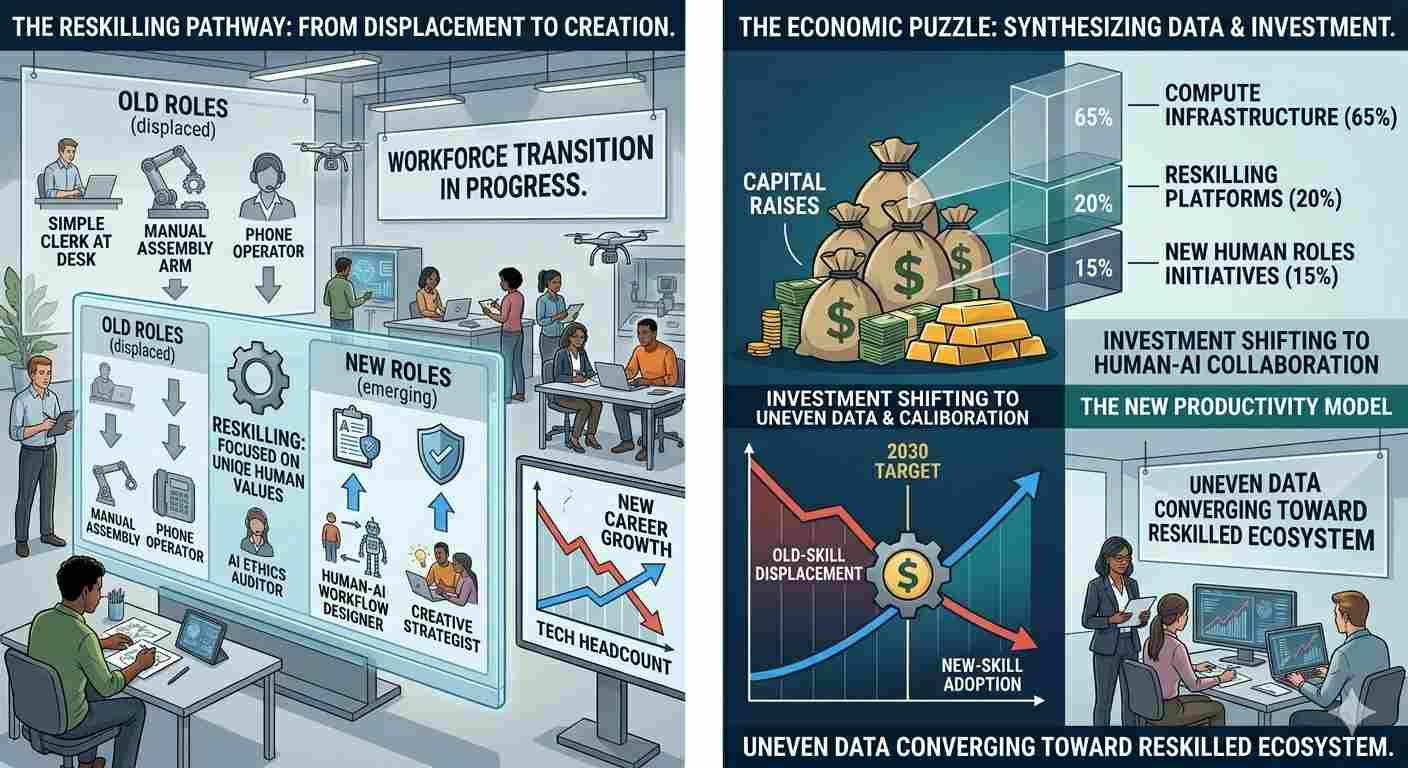
But the layoffs are real, and they are accelerating. AI has been cited as justification for nearly 50,000 job cuts in the United States through April 2026 alone. One social media giant eliminated roughly 8,000 roles — around 10% of its workforce — explicitly citing an AI-driven restructuring. A major financial software company cut 17% of its staff the same month. Across the technology sector, the pattern is consistent: AI spending goes up, headcount goes down, and the money that once funded salaries is being redirected to compute.
Not everyone in the industry is following Altman's softer line. The CEO of Anthropic has maintained that up to half of all entry-level white-collar jobs could dissolve within five years, and that unemployment could reach levels not seen in modern history. "We have a duty to be honest about what is coming," he said last year.
The truth is that no one knows with certainty what the labour market looks like in 2030. The economists disagree. The data is too early and too uneven. What is certain is that the people building this technology have significant financial incentives to shape how the rest of us think about it — and that Altman's change of tone arrives at a moment when those incentives have never been larger.