Google Expands AI-Powered Agriculture Models from India to Southeast Asia and Japan
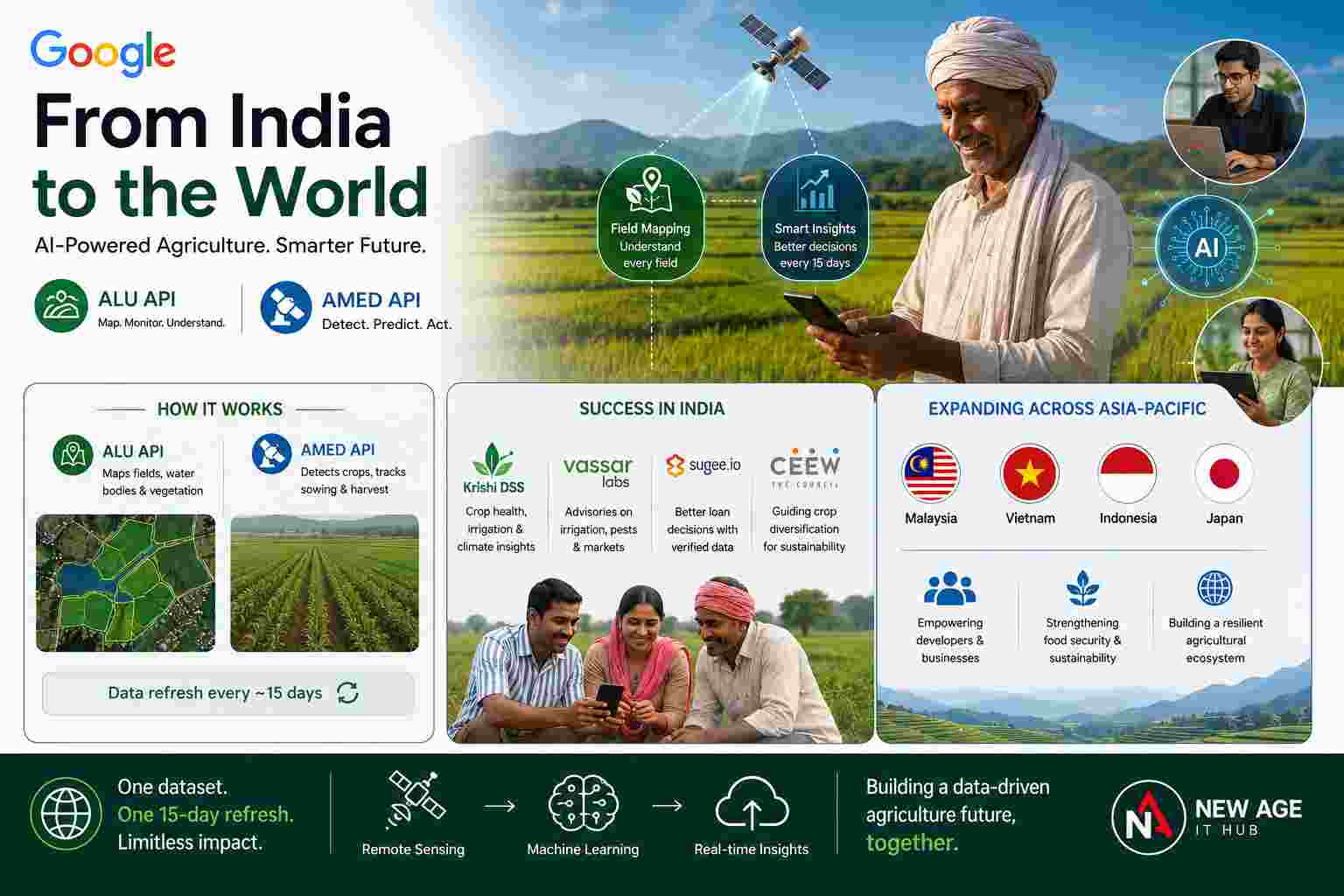
Just months after their India-first release, Google is expanding its artificial intelligence-powered agriculture models to four additional Asia-Pacific nations. The company announced that its Agricultural Landscape Understanding (ALU) and Agricultural Monitoring & Event Detection (AMED) APIs will now be available to trusted testers in Malaysia, Vietnam, Indonesia, and Japan.
The move marks a major milestone in Google's mission to use AI for solving real-world challenges. According to the company, the success of these tools in India has demonstrated how technology can strengthen agricultural resilience and help farmers make better, faster decisions.
"Solutions that address India's most pressing challenges can also solve for the world," Google stated in its announcement, adding that the Asia-Pacific region's similar climatic and farming patterns make it a natural next step.
How the Technology Works
Both APIs rely on remote sensing and machine learning to provide critical insights about crops, soil, and weather conditions:
ALU API: Identifies individual farm fields, water bodies, and vegetation boundaries. This creates a foundational map of the agricultural landscape.
AMED API: Delivers field-level intelligence on the most cultivated crops, along with precise sowing and harvest timelines. The system refreshes data approximately every 15 days, giving farmers and policymakers near real-time visibility into changing agricultural conditions, including floods, droughts, and pest outbreaks.
Together, these models serve as a base layer for developing precision agriculture tools, optimizing resource allocation, and improving farm management practices.
Success Stories from India
Google highlighted several Indian deployments as evidence for wider regional application:
Krishi DSS: Developed by Amnex for the Government of India's Department of Agriculture and Farmer Welfare, this platform uses both APIs for crop health monitoring, acreage estimation, irrigation advisories, and climate impact assessment across districts, tehsils, and villages.
Vassar Labs: Serving over 10 million farmers through various state projects, the company has integrated the APIs into its fieldWISE platform to deliver personalized advisories on irrigation, pest control, fertilizer use, and market dynamics.
Sugee.io: This financial technology firm uses the ALU API to verify land and crop data, improving loan processing for farmers. It also plans to adopt AMED insights for credit risk assessment and event-based repayment monitoring.
CEEW (Council on Energy, Environment and Water): The research body is using the APIs to identify regions best suited for crop diversification, helping farmers shift toward more climate-friendly and profitable crops.
What's Next for Asia-Pacific?
By expanding access to these APIs, Google aims to enable similar innovation in Malaysia, Vietnam, Indonesia, and Japan. The company invited developers, researchers, and agri-businesses across the region to partner and build new applications that enhance food security, sustainability, and farmer livelihoods.
Alok Talekar, Lead for Agriculture and Sustainability Research at Google DeepMind, noted that these local use cases have delivered on the ambition for AI to assist targeted, data-driven action benefiting stakeholders across the agricultural landscape.
The Bottom Line
Google's India-first approach—now extending to neighboring countries—underscores how localized AI research can deliver global impact. One farm, one dataset, and one 15-day refresh cycle at a time, the company is helping transform agriculture from a traditional practice into a data-driven science.
As climate change continues to threaten food security across Asia-Pacific, these freely available APIs may prove to be among the most important tools in the fight for sustainable farming.
Google's Agricultural AI Expansion
| Feature | ALU API | AMED API |
|---|---|---|
| Full Name | Agricultural Landscape Understanding | Agricultural Monitoring & Event Detection |
| Primary Function | Identifies fields, water bodies, vegetation boundaries | Monitors crop cycles, sowing & harvest timelines |
| Data Refresh Rate | Static baseline mapping | Every 15 days (near real-time) |
| Key Use Cases | Land verification, resource mapping, loan processing | Drought/flood detection, irrigation advice, risk assessment |
| Launch in India | October 2024 | Following ALU launch |
| New Markets (2026) | Malaysia, Vietnam, Indonesia, Japan | Malaysia, Vietnam, Indonesia, Japan |
| Technology | Remote sensing + Machine Learning | Remote sensing + Machine Learning |