India’s AI Push Gets a Boost as Zoho Debuts ‘Nathu La’ Server
For decades, India has been a consumer of server technology — paying royalties and licensing fees to foreign entities, importing hardware, and never truly owning the stack. That changed on Tuesday.
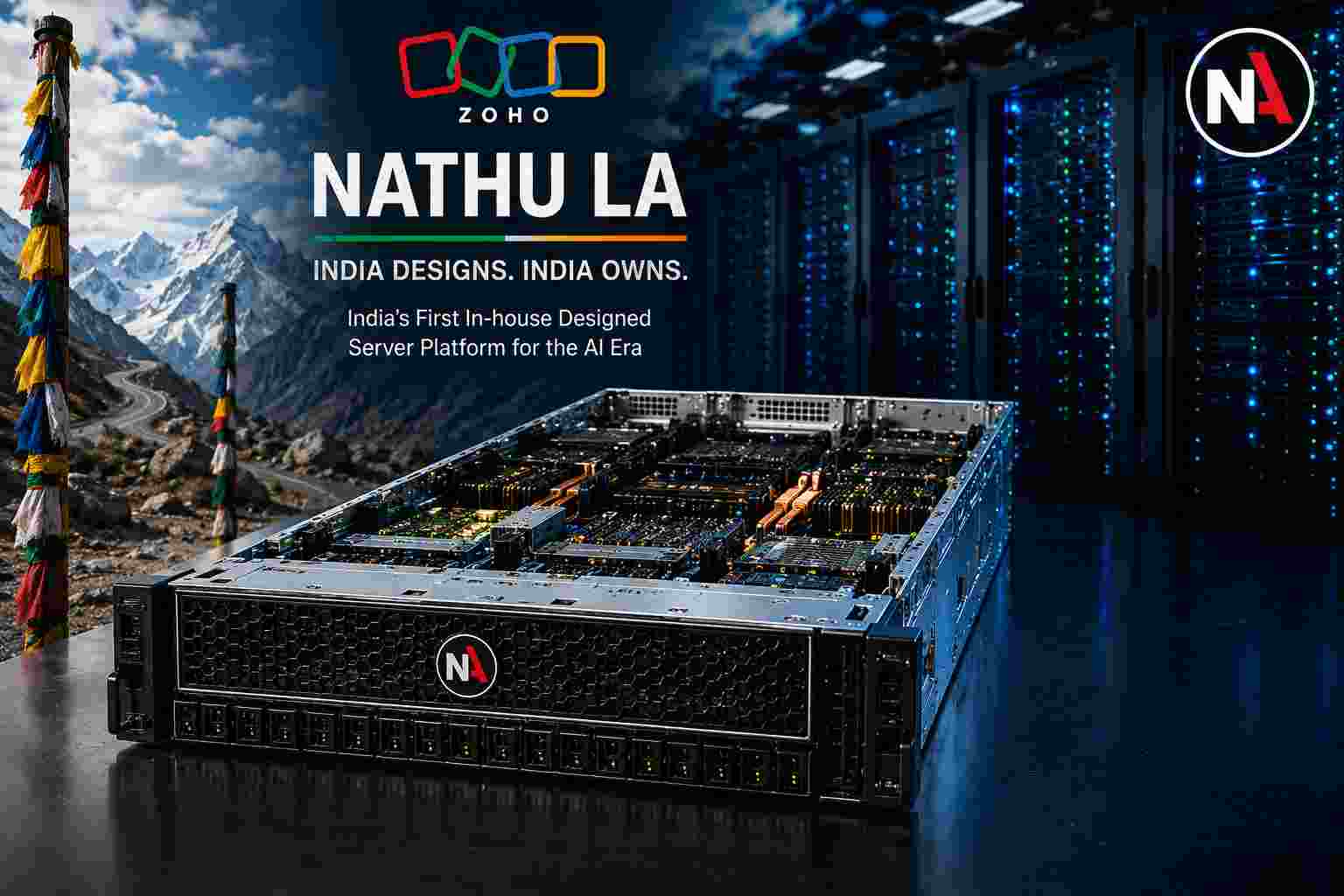
Zoho Corporation, the Chennai-based enterprise software giant, unveiled Nathu La — its first-ever in-house designed server platform. Named after the mountain pass in Sikkim, the server represents a quiet revolution in Indian technology: a piece of mission-critical AI infrastructure designed entirely by Indian engineers, with all intellectual property owned in India.
The Numbers That Matter
Nathu La is not just a symbolic achievement. The performance metrics are striking:
20-30% lower total cost of ownership (TCO) compared to equivalent servers
12-18% lower power consumption for equivalent performance
5 patents filed covering thermal management and cost-optimized server architecture
The server is built around Intel Xeon 6 processors, developed collaboratively with Intel's enablement team. But the rest — the motherboard, the DC-SCM (Data Centre Secure Control Module), the NIC (Network Interface Card), the power delivery subsystems — was designed from scratch by Zoho's hardware engineering team.
The result, according to Zoho CEO Shailesh Davey, is compounding benefits: "With Zoho's strategy of using contextual, right-sized models, running on our own platform, now on our own servers, accelerated by our own GPU database, we are compounding the benefits accrued from owning and operating our entire technology stack."
The Five-Year Journey That Started in Nagpur
Nathu La did not emerge overnight. In 2020, Zoho set up a small team in Nagpur to work on R&D projects — including the audacious idea of designing a server from scratch. Most software companies do not build their own hardware. Zoho decided to do both.
The team included new hires from SETU (Student's Engagement for Transformative Upskilling) — an initiative designed to build a pipeline of industry-ready engineers from colleges across Central India, with a focus on Electronics System Design and Manufacturing (ESDM).
Over 300 students have been trained through SETU. Some of them now work on Nathu La. The program directly confronts a growing concern in technical education: the erosion of foundational skills in an era of AI-assisted learning.
"The development of the Nathu La server reflects our commitment to creating complex technology powered by talent from smaller towns and villages," Davey said.
What's Inside Nathu La
The server platform is the result of five years of R&D across hardware, firmware, and systems management. It is designed to optimize performance for:
Virtualization (VM)
High Performance Computing (HPC)
AI inference
Storage applications
All modular components are assembled through partnerships with Indian Electronic Manufacturing Services (EMS) firms, ensuring end-to-end domestic value addition. The server supports the Open Compute Project (OCP) with a focus on modularity, thermal efficiency, and ease of maintenance.
Why This Matters for India's AI Future
The launch comes at a critical moment. Enterprise adoption of AI is driving higher spending on inference — the process of running AI models to generate outputs. Zoho co-founder Sridhar Vembu recently warned that dependence on foreign AI compute infrastructure could become an "oil import bill" for the AI era, adding burden to India's current account deficit.
Zoho itself spends "a few million a year" on AI model subscriptions, Vembu said. Nathu La is designed to bring that cost down — not just for Zoho, but potentially for Indian enterprises that adopt the platform.
The company has already deployed 1,000 Nathu La servers across production and pre-production, with a target of 2,000 by the end of 2026.
The Sovereignty Angle
Nathu La is engineered with hardware-rooted security at every layer. The platform's entirely indigenous IP means there is no dependency on foreign entities for security audits, firmware updates, or licensing continuity.
The solution is fully aligned with India's Open Source Software (OSS) policy and the highest Local Content Policy standards, supporting government initiatives including Make in India, Atmanirbhar Bharat Abhiyaan, and the National Supercomputing Mission (NSM).
What Comes Next
Zoho plans to host its own applications on Nathu La, optimizing the full software-hardware stack for its specific workloads. The company is also positioning the server for government procurement and broader enterprise adoption.
For now, Nathu La is a statement: India can design, build, and own critical AI infrastructure. The question is whether the rest of the country's tech industry will follow Zoho's lead.