Elon Musk’s Shift From Earth-Based Solar to Space-Powered AI Sparks Debate
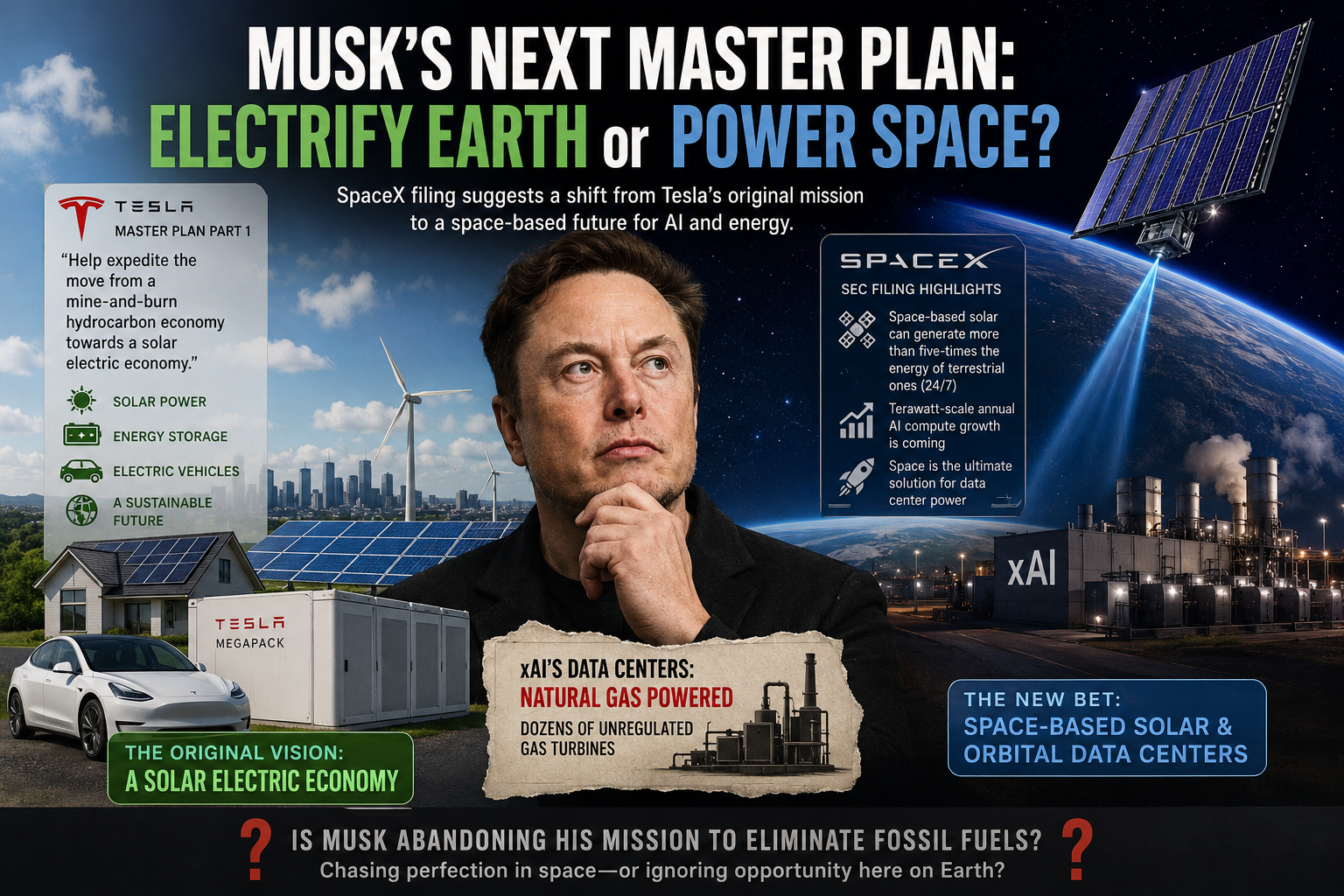
Elon Musk’s long-standing vision of building a solar-powered electric economy is facing renewed scrutiny as his companies increasingly invest in artificial intelligence infrastructure powered by fossil fuels and experimental space-based energy concepts. Over the years, Tesla’s Master Plans promoted a future centered on renewable energy, electric vehicles, battery storage, and the elimination of hydrocarbon dependence. However, recent developments suggest that priorities may be shifting toward supporting massive AI growth, even if that means relying heavily on natural gas in the short term.
xAI, Musk’s artificial intelligence company, has rapidly expanded its data center operations using large-scale gas turbine systems to meet rising compute demands. The company has also reportedly invested billions into energy infrastructure and battery storage systems capable of stabilizing enormous power loads created by AI training and inference. While Tesla energy products such as Megapacks continue to play a role in these operations, the noticeable absence of large-scale terrestrial solar deployment has fueled speculation that Musk’s clean energy ambitions are evolving in a different direction.
The growing focus on space-based solar energy has become one of the most controversial parts of this strategy. The concept involves placing solar arrays in orbit where they can collect sunlight continuously without interruptions from weather or nighttime conditions. Supporters believe orbital solar systems could eventually generate significantly more energy than traditional Earth-based solar farms and provide uninterrupted electricity for future AI infrastructure.
At the same time, many experts question the practicality and economics of such a system. Launching satellites, transporting hardware into orbit, and protecting advanced computer systems from radiation and harsh space conditions would require enormous investment and technological breakthroughs. Critics also argue that Earth still has vast untapped solar potential that could be expanded faster and more efficiently using existing renewable technologies.
Artificial intelligence remains the driving force behind these discussions. Global AI demand is growing at an unprecedented pace, and companies are increasingly worried that current electrical grids may struggle to support future computing requirements. Musk’s companies appear to believe that future AI systems could require terawatt-scale energy capacity, far beyond the levels used by modern data centers today. This belief is shaping investment decisions across energy storage, infrastructure, and experimental power generation projects.
Despite concerns, Musk’s supporters argue that his companies have historically succeeded by pursuing ambitious ideas that initially seemed unrealistic. Electric vehicles, reusable rockets, and satellite internet networks were all once considered impossible at scale. They believe space-based solar power could eventually become another transformative breakthrough if the technology matures successfully.
However, critics warn that relying on fossil fuels while waiting for futuristic energy systems could undermine global climate goals and contradict earlier promises to accelerate the transition away from carbon-heavy energy sources. The debate now centers on whether Musk’s evolving strategy represents a temporary compromise driven by AI demand or a permanent shift away from the original vision of a fully Earth-based solar-powered economy.