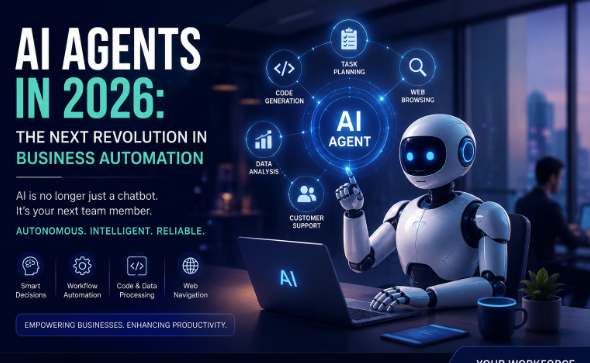
AI agents are rapidly evolving beyond chatbots into autonomous digital workers capable of coding, planning, and executing complex business tasks with minimal human oversight.
The artificial intelligence landscape is undergoing a profound transformation that extends far beyond the conversational chatbots that captured the world's attention over the past few years. A new class of AI systems known as autonomous agents is rapidly emerging as the next frontier in enterprise technology, with the potential to reshape how businesses operate across virtually every industry. These AI agents are not merely tools that respond to prompts; they are sophisticated digital workers capable of planning complex tasks, writing and executing code, navigating the web independently, and automating entire workflows with minimal human intervention. Industry analysts and technology executives are increasingly describing this shift as one of the most consequential enterprise trends of 2026, with implications that rival the advent of cloud computing and the mobile revolution.
Unlike traditional AI models that require precise instructions for each individual task, modern AI agents are designed to operate with a degree of autonomy that fundamentally changes the nature of human-machine collaboration. These systems can break down high-level objectives into actionable steps, make decisions based on real-time information, and adapt their approach when encountering obstacles. For example, an AI agent assigned to research competitors could independently browse dozens of websites, synthesize findings into a comprehensive report, and even draft a presentation summarizing key insights, all without requiring a human to guide each step of the process. This capability represents a significant leap forward in productivity and is driving intense interest from businesses seeking to gain a competitive edge in an increasingly automated economy.
The practical applications of AI agents are already visible across multiple sectors. In software development, agents are being deployed to write, test, and debug code, dramatically accelerating development cycles and reducing the burden on engineering teams. In customer service, agents can handle complex support tickets by accessing multiple databases, resolving issues, and following up with customers without human oversight. In financial services, autonomous agents are being used to analyze market data, execute trades, and monitor compliance with regulatory requirements. In healthcare, agents are assisting with patient scheduling, medical record analysis, and even preliminary diagnostic support. The versatility of these systems is one of their most compelling attributes, making them applicable to virtually any industry that relies on information processing and repetitive decision-making.
The economic implications of AI agents are substantial. By automating routine and even semi-complex tasks, these systems allow human workers to focus on higher-value activities that require creativity, strategic thinking, and emotional intelligence. This shift is expected to boost productivity across the economy, potentially adding trillions of dollars to global GDP over the coming decade. However, the rise of AI agents also raises important questions about the future of employment, the nature of work, and the skills that will be most valuable in an increasingly automated world. While some experts predict that AI agents will create new categories of jobs focused on managing and supervising these digital workers, others warn of significant disruption to traditional white-collar occupations.
Technology companies are racing to capture a share of the growing market for AI agents. Major cloud providers have introduced platforms that allow businesses to develop and deploy custom agents tailored to their specific needs. Startups specializing in agentic AI have attracted billions of dollars in venture capital funding, with valuations soaring as investors bet on the transformative potential of autonomous systems. The competition has intensified to the point where industry observers describe the current environment as reminiscent of the early days of the internet, when companies scrambled to establish themselves as leaders in a new technological paradigm. The pace of innovation in this space is extraordinary, with new capabilities being introduced on a weekly basis.
Despite the enthusiasm, significant challenges remain before AI agents can achieve their full potential. Reliability and accuracy are major concerns, as agents operating with autonomy can make errors that are difficult to detect and correct. The problem of AI hallucination, where systems generate plausible but incorrect information, is particularly problematic in contexts where precision is critical. Additionally, security and privacy issues arise when agents are granted access to sensitive data and systems, raising the stakes for robust governance frameworks and monitoring protocols. Businesses deploying AI agents must invest in careful testing, validation, and oversight to ensure that these digital workers perform as intended and do not introduce new risks.
The regulatory landscape is also evolving in response to the rise of AI agents. Policymakers in major economies are considering rules that would require transparency in automated decision-making, accountability for the actions of autonomous systems, and safeguards to prevent misuse. The European Union, in particular, has been at the forefront of efforts to establish a legal framework for AI, with provisions that would impose stricter requirements on high-risk applications of agentic technology. Companies developing and deploying AI agents must navigate this complex regulatory environment while continuing to innovate and deliver value to their customers.
Looking ahead, the trajectory of AI agents suggests that they will become increasingly integrated into the fabric of business operations. The technology is expected to become more capable, more reliable, and more accessible over time, lowering the barriers to entry for organizations of all sizes. Industry experts predict that by the end of the decade, AI agents will be as commonplace in the workplace as email and spreadsheets are today. The organizations that embrace this technology early and develop the capabilities to manage it effectively will be well-positioned to thrive in the new competitive landscape.
The transformation is already underway, with early adopters reporting significant gains in efficiency, accuracy, and employee satisfaction. As AI agents continue to evolve and mature, their impact on business will only deepen, making them an essential component of modern enterprise strategy. The question for business leaders is no longer whether to adopt AI agents, but how quickly they can integrate these powerful tools into their operations while managing the associated risks and challenges. The emergence of AI agents as the new workforce represents not just a technological shift but a fundamental reimagining of how work gets done in the digital age.