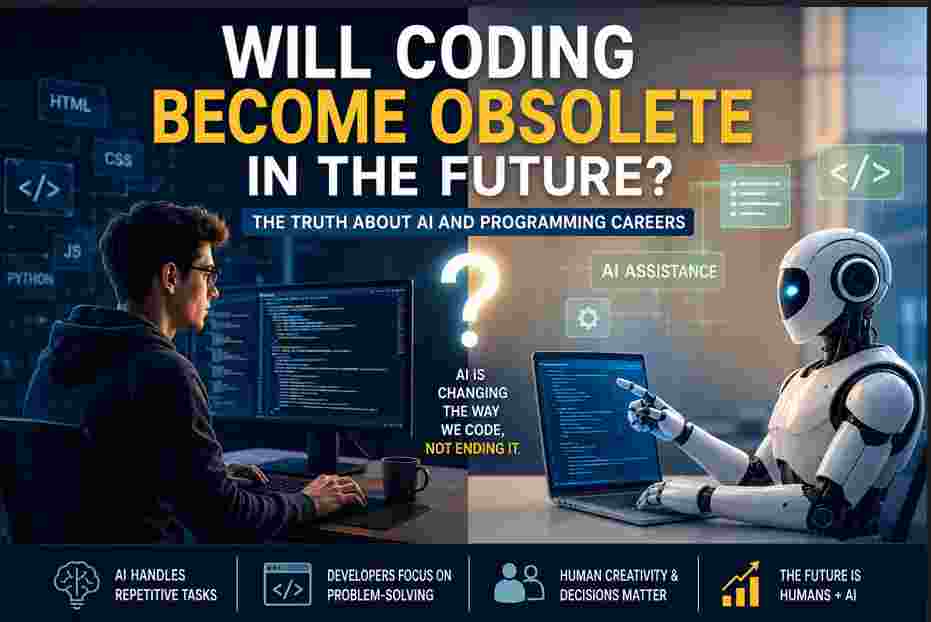
Everyone's saying AI killed coding. Here's the uncomfortable truth nobody's telling you — and why the developers who panic are about to get left behind by the ones who adapt.
Is Coding Dead? The Question Every Developer Is Afraid to Ask :-
Somewhere right now, a computer science student is staring at their laptop, watching an AI write a working function in four seconds — something that would've taken them twenty minutes last year — and quietly wondering if they just wasted their tuition money.
That fear is real. It's also, mostly, wrong.
The Panic Is Loud. The Truth Is Quieter :-
Every few years, tech has a "this job is over" moment. Calculators were going to end mathematicians. Photoshop was going to end painters. No-code tools were going to end developers — a decade ago. None of it happened the way the headlines said it would.
What actually happens is simpler and less dramatic: the tool absorbs the boring part of the job, and the job shrinks around what's left.
That's exactly what's happening with coding right now. AI didn't kill programming. It killed typing. And those were never the same thing.
What AI Is Genuinely Good At (No Sugarcoating) :-
Let's be honest about where AI actually wins:
- Writing boilerplate and repetitive functions in seconds
- Fixing common bugs and syntax errors instantly
- Generating first drafts of scripts, APIs, and CRUD apps
- Explaining unfamiliar code faster than any documentation
If your job was mostly this — congratulations, that part of your job is gone. Not "going away eventually." Gone. Today.
What AI Is Still Genuinely Bad At :-
Here's what nobody puts in the clickbait headline:
- Understanding why a business needs a feature, not just how to build it
- Catching a bug that only shows up under a specific edge case in a five-year-old legacy system
- Making the call between "fast but risky" and "slow but safe" architecture
- Knowing when the AI's confident, clean-looking answer is quietly wrong
AI doesn't have skin in the game. It doesn't get paged at 2 a.m. when production breaks. It doesn't sit in a meeting and read the room when a client says "it's fine" but clearly means the opposite. Those things aren't small. They're the actual job.
The Real Shift Nobody's Talking About :-
The developer of 2026 isn't becoming obsolete — they're becoming an editor, an architect, and a decision-maker instead of a typist. Coding is turning into less of a typing skill and more of a thinking skill.
That's a harder shift for some people than others. If your only skill was memorizing syntax, that's genuinely at risk. If your skill was solving problems and syntax was just the language you used to express the solution — you're about to become more valuable, not less.
So, Should You Still Learn to Code?
Yes. But learn it like someone who plans to work with AI, not against it. Focus less on memorizing every method name and more on understanding logic, systems, and why software behaves the way it does. Learn to read AI-generated code critically instead of copy-pasting it blindly. That single habit will separate you from 90% of people entering the field.
The Bottom Line :-
Coding isn't dying. The version of coding that was just "typing lines really fast" is dying — and honestly, it should. What's replacing it is a version of the job that rewards thinking, judgment, and taste more than speed.
The people who'll struggle aren't the ones using AI. They're the ones who never learned to think without it.
So no — coding isn't over. It's just finally becoming what it was always supposed to be: a way to solve problems, not just a way to type fast.